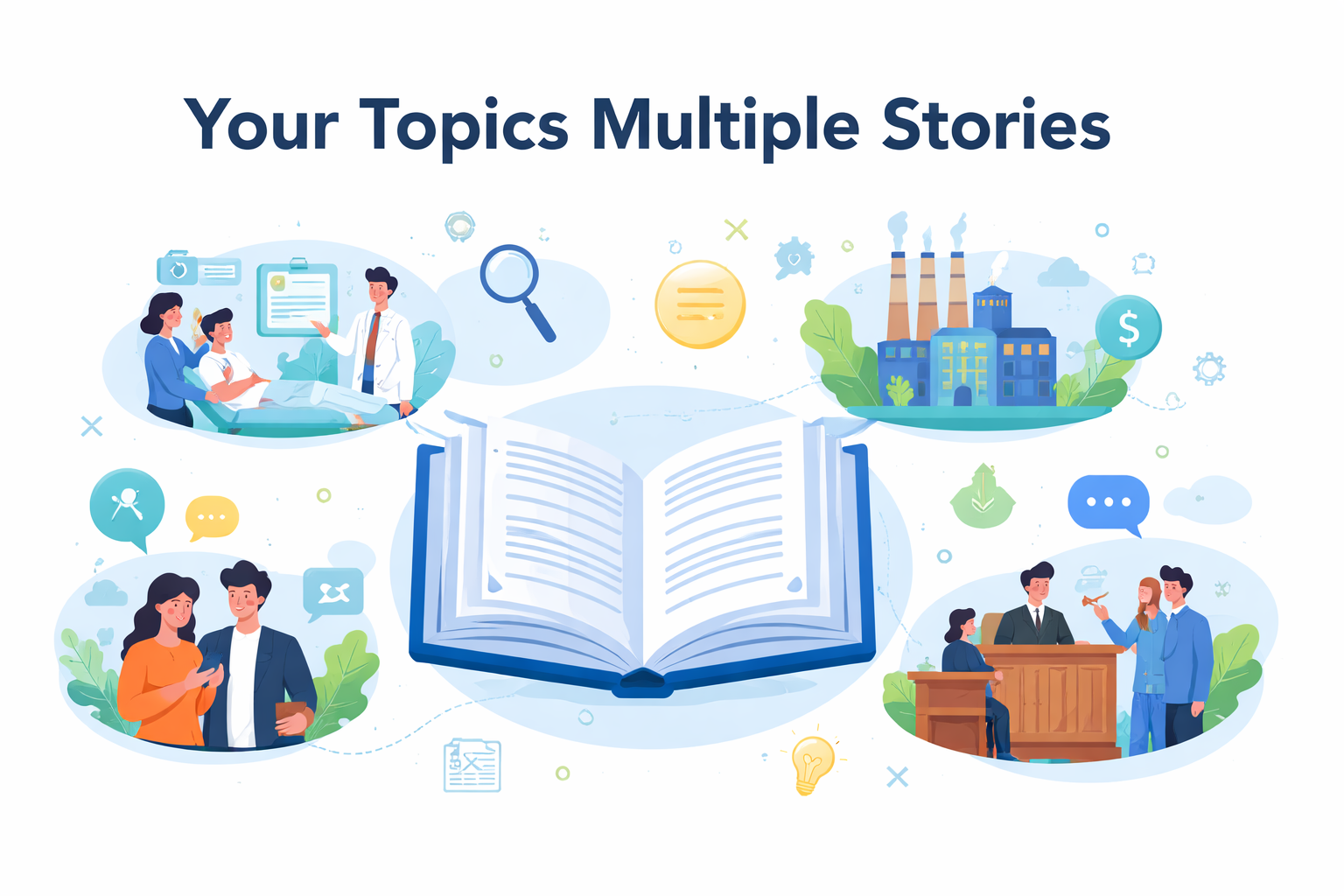
The way we consume and process information often defaults to oversimplification. We encounter a subject, assign it a single, easily digestible narrative, and file it away. However, reality is rarely one-dimensional. Just as a prism takes a single beam of white light and fractures it into a vast spectrum of distinct colors, any single subject contains a multitude of narratives waiting to be uncovered.
As a researcher, long-form content writer, or analytical thinker, the most critical skill one can develop is the ability to look at a singular subject and extract the diverse, often competing narratives hidden within it. Moving from a broad subject to specific, targeted narratives transforms passive information consumption into active critical thinking. By applying the concept of Your Topics Multiple Stories, researchers can elevate their work from surface-level summaries to profound, multidimensional explorations. Here is a comprehensive look into why shifting from a single-angle mindset to a multi-narrative approach is essential for modern analysis, communication, and understanding.
Your Topics Multiple Stories
To truly understand this concept, we must first distinguish between a broad topic and a specific story. A topic is the overarching subject matter—the “what.” It is an objective fact, an event, a technological trend, or an industry. It is broad, static, and often entirely neutral. Subjects like “Artificial Intelligence,” “Global Supply Chains,” and “Remote Work” are topics. They act as the container for information, but they do not inherently tell you anything about the human experience or the underlying conflicts.
A story, on the other hand, is the specific narrative, angle, or perspective derived from that topic. It is the “why,” the “how,” and the “who.” A story provides a lens through which we interpret the topic, driven by human impact, stakes, conflicts, and resolutions.
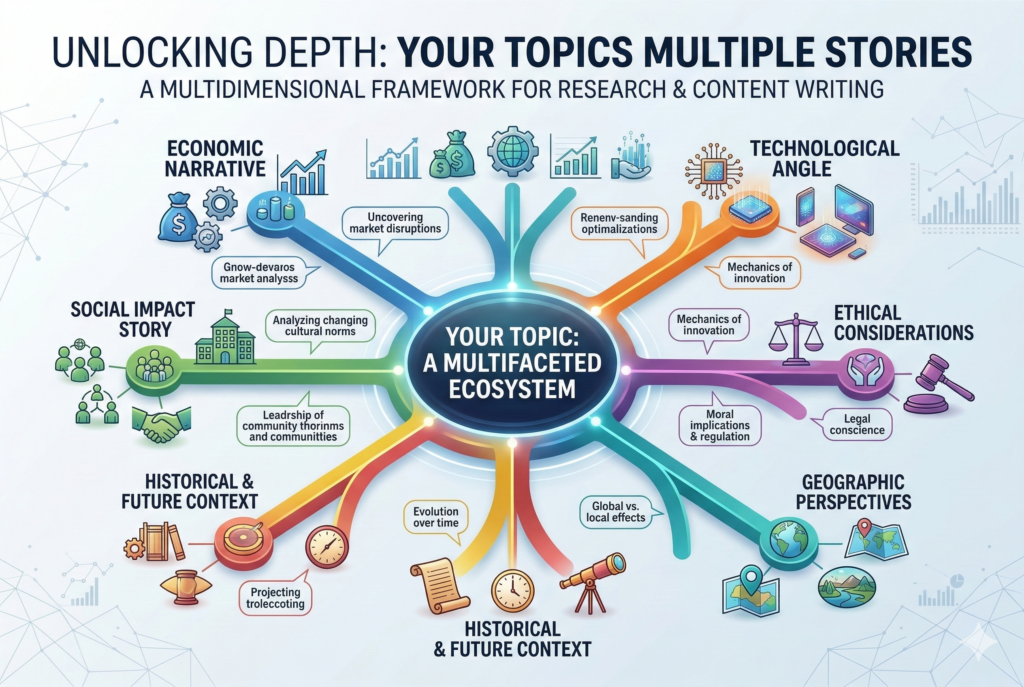
When we explore this framework, we refer to the analytical practice of taking a single, broad container (the topic) and systematically unpacking the numerous, diverse narratives (the stories) that exist inside it. Every topic is a multifaceted ecosystem. By recognizing that one topic houses multiple intersecting narratives, journalists, content writers, and business leaders can avoid reductionist thinking and present a much more accurate reflection of reality. A singular topic is merely the starting point; the varying narratives are the true destinations.
The Contextual Layers of a Topic
To successfully extract varied narratives from a single subject, one must understand the underlying anatomy that makes any topic multidimensional. Uncovering these angles requires asking specific, investigative questions that slice through the subject from different directions and explore its contextual layers.
The Temporal Context
Every subject exists within a continuous web of time. Exploring this layer naturally yields different narratives depending on where you place your focus. The story of the past relies on historical precedent, origin stories, and the initial catalysts that brought the topic into existence. The story of the present looks at immediate impacts, current friction points, and real-time execution. Finally, the story of the future involves forecasting, predictive modeling, and understanding long-term consequences.
The Geographic Context
How does this subject manifest differently across physical borders and cultural boundaries? A global topic like “water scarcity” tells a very different story in the American Southwest compared to the story it tells in Sub-Saharan Africa. Geographic context forces a writer to acknowledge that policies, innovations, and social movements do not happen in a vacuum—they interact with local geographies, resources, and established infrastructures.
The Stakeholder Context
A topic affects different groups of people in vastly different ways. Identifying the stakeholders is often the fastest and most reliable route to discovering new narratives. Who are the primary beneficiaries profiting or gaining an advantage from this trend? Conversely, who are the disadvantaged or marginalized groups bearing the cost or the unintended consequences? Furthermore, what do the observers—regulators, scientists, or sociologists—have to say about the shifting dynamics?
Core Perspectives to Extract Narratives
When evaluating a subject, researchers can reliably generate fresh material by applying a standard set of thematic lenses. Actively implementing Your Topics Multiple Stories requires a deliberate shift in perspective, moving through various professional and social viewpoints to see how the subject changes under different lights.
The Economic Angle
Almost every subject has a financial heartbeat. The economic perspective looks closely at the flow of money, resource allocation, market disruptions, and financial incentives. It asks critical questions: What is the true cost of this development? Who is funding it, and who stands to profit the most? How does this alter the existing market equilibrium? By following the money, writers often uncover the most pragmatic and grounded narrative within a broader subject.
The Social and Cultural Angle
This perspective focuses deeply on human behavior, societal norms, and cultural shifts. It examines how a macro-level topic influences the micro-level way people live, communicate, and relate to one another on a daily basis. It asks: How does this change our community structures? Does it challenge deeply held cultural values or reinforce them? The social angle brings a necessary human element to topics that might otherwise feel overly technical or abstract.
The Scientific and Technological Angle
For subjects rooted in innovation, the technological perspective explores the raw mechanics of how things work, the rapid pace of advancement, and the specific scientific breakthroughs required to make progress possible. It asks: What are the physical, digital, or biological mechanisms driving this forward? What are the hard limitations of this technology? This angle grounds theoretical discussions in concrete science and engineering realities.
The Ethical and Legal Angle
This is frequently the most complex and contested narrative to write. It investigates the moral implications, regulatory frameworks, privacy concerns, and human rights aspects of a subject. It asks the ultimate philosophical question: Just because we possess the capability to do this, does it mean we actually should? Who holds the legal responsibility when these systems fail or cause harm?
Real-World Examples in Action
To clearly illustrate how this framework operates in practice, let us examine two contemporary subjects and break them down into their constituent narratives.
Case Study 1: The Transition to Electric Vehicles
If a writer only looks at the surface level, the narrative is overly simplistic: “The world is adopting electric cars to save the environment.” However, applying a multidimensional lens reveals a rich, complex tapestry of distinct narratives:
-
The Environmental Narrative: This focuses on the reduction of greenhouse gas emissions, the phasing out of fossil fuels, and the potential for mitigating the worst effects of climate change through cleaner tailpipe emissions.
-
The Supply Chain Narrative: This explores the intense global race to secure rare earth minerals like lithium and cobalt. It highlights the reliance on specific nations for battery production and the serious ethical concerns surrounding mining practices and labor laws.
-
The Infrastructure Narrative: This looks at the logistical challenges and massive capital investment required to build reliable, ubiquitous charging networks and to upgrade aging national power grids so they can handle the massive increase in electrical load.
-
The Workforce Narrative: This examines the disruption of the traditional auto mechanic industry, as electric vehicles require significantly less routine maintenance, threatening legacy jobs while simultaneously creating new, highly skilled positions in battery technology and software development.
Case Study 2: The Integration of Artificial Intelligence in Healthcare
A one-dimensional view simply states: “AI is making healthcare faster.” Beneath that surface lies a web of varied, deeply impactful stories:
-
The Diagnostic Narrative: The technological leap where machine learning algorithms can analyze medical imaging—such as X-rays and MRIs—with a higher degree of accuracy and speed than human radiologists, catching diseases earlier.
-
The Privacy Narrative: The ethical and legal concerns regarding who owns the massive datasets of patient health records required to train these AI models, and how vulnerable that highly sensitive data is to breaches or corporate misuse.
-
The Accessibility Narrative: The socioeconomic story of whether these advanced AI medical tools will be available to rural and low-income clinics, or if they will only be deployed in wealthy, urban research hospitals, thereby widening the existing healthcare inequality gap.
The Benefits of Exploring Multiple Angles
Adopting a multidimensional methodology provides immense, tangible value not just to content writers and researchers, but to the readers, business leaders, and policymakers who rely on their work.
First, it is the most effective way to combat inherent bias and intellectual echo chambers. By actively seeking out the economic, social, and ethical angles within a subject, we bypass our own confirmation bias. It forces us to acknowledge complex realities that may contradict our initial assumptions, resulting in a much more intellectually honest and rigorous assessment.
Second, it fosters empathy and nuance in public discourse. Single narratives often rely on creating simplistic “heroes” and “villains.” Multiple narratives introduce necessary nuance. Understanding that a new environmental policy might be a massive win for the climate while simultaneously devastating the economy of a local mining town fosters a more empathetic, comprehensive worldview.
Finally, it leads to superior decision-making. For executives and policymakers, looking at only one angle is a guaranteed recipe for unintended, negative consequences. By mapping out all the variables—the technological leaps, the human costs, the legal hurdles—leaders can formulate holistic, well-rounded strategies that accurately anticipate and mitigate long-term risks.
Future Relevance in the Digital Age
As we move deeper into an era characterized by information overload, the volume of data we process daily is staggering. Algorithmic social media feeds and search engines are frequently designed to serve us the single, isolated story that most closely aligns with our pre-existing beliefs, hyper-polarizing our view of the world. In this fractured media landscape, embracing Your Topics Multiple Stories will become an indispensable survival skill for achieving true media literacy.
Furthermore, as generative artificial intelligence becomes increasingly adept at producing basic, surface-level overviews of broad subjects, the true value of human writers and researchers will lie entirely in their ability to curate, connect, and contextualize multiple, highly nuanced angles. The premium in the content market will be placed on lateral thinking—the uniquely human ability to look at a singular event, synthesize disparate data points, and clearly articulate the complex ripple effects across society, economics, culture, and law.
Conclusion
A broad subject is merely a locked door; the varied, intersecting narratives are the keys required to understand exactly what lies behind it. By thoroughly examining the contextual layers, engaging with the realities of different stakeholders, and relentlessly applying economic, social, technological, and ethical lenses, we transform flat, uninspired information into deep, actionable insight. Whether you are analyzing global supply chains, technological revolutions, or subtle cultural shifts, the core philosophy of Your Topics Multiple Stories remains a powerful, foundational tool. Embracing the multitude of perspectives within a single container is the ultimate hallmark of sophisticated, impactful, and enduring research.
You may love to Read- how can creating goals build or maintain a positive lifestyle