
We have been sold a lie about what it means to be self-assured. We are told it is a lightning bolt that strikes some people at birth, or a “hack” that can be unlocked by shouting affirmations at a bathroom mirror. We are told to “fake it until we make it,” as if the world won’t notice the tremors in our voice if we just wear a louder suit.
The reason most people struggle with how to be confident is that they are waiting to feel brave before they start acting. They treat confidence as a prerequisite for action, when in reality, it is the byproduct of it. This disconnect is why traditional motivational advice fails: it focuses on the internal state (how you feel) rather than the external evidence (what you have done).
True confidence isn’t the absence of fear or the presence of bravado. It is the quiet, grounded knowledge that you can handle a situation, regardless of the outcome.
Defining the Terms: Confidence vs. Arrogance vs. Self-Esteem
To build a solid foundation, we must first define what we are actually building. In common parlance, these three terms are often used interchangeably, but they represent very different psychological foundations.
Confidence
Confidence is situational competence. It is the belief in your ability to succeed at a specific task. You might be highly confident in your ability to drive a car but have zero confidence in your ability to perform heart surgery. It is rooted in reality and evidence.
Arrogance
Arrogance is a defensive mechanism. It is an exaggerated sense of one’s own importance or abilities, often used to mask a deep-seated insecurity. While confidence says, “I am capable,” arrogance says, “I am better than you.” Arrogance requires an audience to validate it; learning how to be confident allows you to be comfortable in silence.
Self-Esteem
Self-esteem is your overall sense of self-worth. It is the baseline of how much you like and respect yourself as a human being. While you can have low confidence in a specific skill (like public speaking) but still have high self-esteem, a complete lack of confidence across many areas often begins to erode self-esteem over time.
Why We Lack Confidence: The Internal Barriers
If confidence is a natural byproduct of growth, why do so many of us feel stuck in a state of perpetual doubt? The barriers are rarely a lack of “talent.” Instead, they are psychological anchors that keep us tethered to our comfort zones.
-
Fear of Judgment: We are social creatures. Evolutionarily, being cast out of the “tribe” meant death. Today, that instinct manifests as a paralyzing fear of looking stupid.
-
The Comparison Trap: In the digital age, we compare our “behind-the-scenes” footage with everyone else’s “highlight reel.“
-
The Weight of Past Failures: Many people carry a “failure resume” in their heads. One bad experience becomes a permanent label: “I’m not good at this.“
-
The Competence Gap: Sometimes, you feel unconfident because you aren’t skilled yet. This isn’t a character flaw; it’s a data point.
The Core Principle: Action Over Affirmation
If you take nothing else from this guide, remember this: Confidence is a lagging indicator.
You cannot think your way into a new way of being. If you sit on your couch trying to convince yourself you are a great public speaker without ever standing behind a podium, your brain will reject the thought because it has no evidence to support it. The brain is a sophisticated lie detector. It requires “proof of work.“
Confidence grows through developing competence. When you do a difficult thing and survive, your brain updates its internal map. It says, “Oh, we did that, and we didn’t die. Maybe we can do it again.“
Practical, Research-Based Strategies
Building a strong presence is a manual process. It requires a blue-collar approach to your own psychology. Here is how to be confident through the foundation of skill-building.
1. The Strategy of “Small Wins”
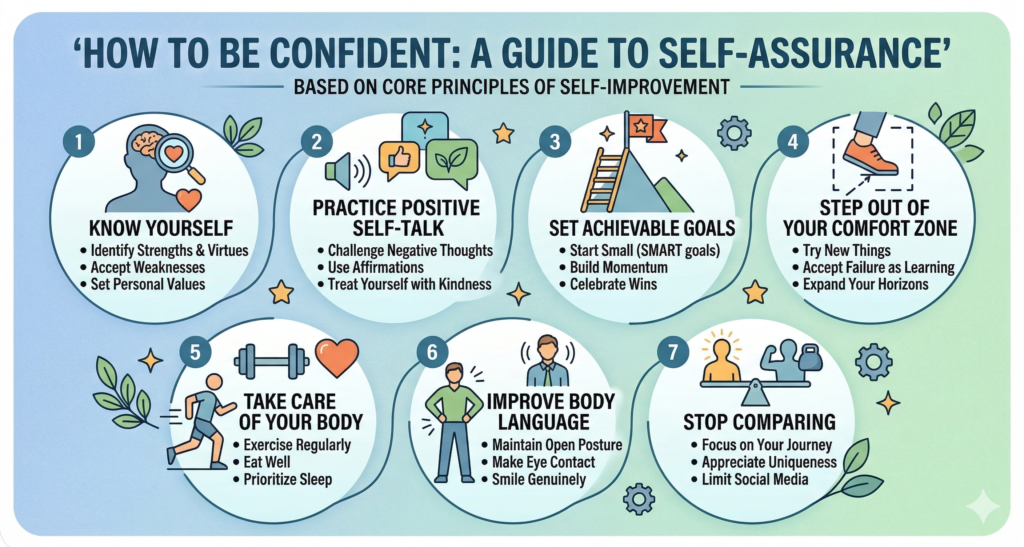
The fastest way to build confidence is to set a small, manageable goal and achieve it. These are “micro-promises” to yourself. If you promise yourself you will walk for ten minutes and you actually do it, you build trust with yourself.
Action: Choose a skill you want to develop. Break it down into the smallest possible unit. Don’t try to “be a writer”; try to write 50 words today.
2. Radical Skill Development
Confidence is often just the outward expression of competence. If you feel insecure at work, it might be because you haven’t mastered the tools of your trade. Instead of trying to “feel” more secure, spend three months developing competence through mastery of your subject matter. When you know your subject matter deeply, confidence is the natural result.
3. Improving Body Language (The Feedback Loop)
While “power posing” has been debated, the link between physiology and psychology is undeniable. Slumping and avoiding eye contact sends a signal to your brain that you are under threat.
-
The “Open Frame”: Keep your shoulders back and your chest open.
-
Eye Contact: Practice holding eye contact for one second longer than is comfortable. These aren’t tricks to fool others; they are signals to your own nervous system that you are safe.
4. Reframing Failure as Data
Confident people do not view failure as a reflection of their identity. They view it as a diagnostic tool. Learning how to be confident means externalizing failure so you can protect your self-esteem while maintaining the ability to improve.
5. Curating Your Environment
If you are surrounded by people who constantly belittle your ambitions or highlight your flaws, understanding how to be confident is like trying to grow a fire in a rainstorm. You need a “supportive environment” of people who hold you to a high standard and encourage your growth.
Realistic Scenarios: The Path of Progression
Consider the example of Sarah, a junior software engineer who was terrified of speaking up in meetings. She focused on taking action despite fear rather than waiting for the fear to vanish.
She didn’t wake up one day and deliver a keynote. Instead, she followed a realistic progression:
-
Week 1: She committed to asking one clarifying question in a small team meeting.
-
Week 3: She volunteered to provide a two-minute update on her specific task.
-
Month 2: She noticed a bug and proposed a solution in front of the senior lead.
-
Month 6: She led a 20-minute presentation.
Sarah’s journey shows how to be confident through a series of increasingly difficult challenges. She allowed herself to be “clunky” and nervous in the beginning.
Debunking the Myths of the “Natural”
We often look at charismatic leaders and assume they were born with a “confidence gene.” This is almost never true.
Myth 1: “Confident people aren’t afraid.”
The truth is that confident people feel the same physical symptoms of anxiety—racing heart, sweaty palms—as everyone else. The difference is their interpretation. They interpret those signals as “excitement” or “readiness.”
Myth 2: “You must be 100% sure of yourself.”
Confidence is not certainty. Real confidence is being 60% sure you can do it, and 100% sure you can handle it if you fail.
Myth 3: “Confidence is a permanent state.”
Confidence fluctuates. You can feel like a titan in your professional life and like a clumsy teenager in a new dance class. This is normal.
The Discipline of Self-Talk
While “positive thinking” is often overhyped, negative self-talk is a genuine deconstructor of confidence. Many of us speak to ourselves in ways we would never speak to a friend.
If your internal monologue is a constant stream of “You’re going to mess this up,” it creates a cognitive load that makes failure more likely. Part of how to build real confidence is moving away from self-criticism toward neutrality.
Instead of “I’m going to ruin this presentation,” try: “I have prepared for this, and I am going to deliver the information I have.” Stick to the facts.
Conclusion: The Long Road to a Solid Self
Real confidence is not a flashy, immediate transformation. It is a slow-motion construction project. It is built in the quiet moments when you choose to do the work instead of checking your phone, when you choose to have the difficult conversation instead of staying silent, and when you choose to get back up after a public mistake.
There are no shortcuts to how to be confident. You cannot bypass the “awkward phase” of learning a new skill. You cannot avoid the discomfort of growth. But if you focus on developing competence, taking action despite fear, and being honest with yourself about your progress, confidence will arrive unbidden.
Stop waiting for the feeling. Start with the action. The feeling will catch up when it sees the proof.